English
 Deutsch
 español
 العربية
 中文

A carton that seals perfectly in the warehouse can arrive opened, crushed, or resealed by hand after an international journey — and the failure is rarely the tape alone. Between the packing bench and the destination, a carton is stacked, dropped, trucked, containerized, unloaded, and handled again, often through humidity and temperature swings that a domestic shipment never sees. International sealing is therefore a different job from local sealing: the seal has to survive the journey, show tampering if it has been opened, and hold a carton that may sit at the bottom of a stack for weeks. This guide sets out how to seal for that journey.
Four stresses separate export cartons from domestic ones. Humidity: a sealed container crossing climates can sweat, and damp board weakens a seal that was strong when dry. Handling count: every transfer is a chance for a carton to be dropped, dragged, or opened for inspection. Stacking load: cartons at the bottom of a pallet or container carry weight for the whole transit time, not just a truck ride. Time: a seal that holds for three days may creep, lift, or dry out over three weeks. The rule: seal for the worst leg of the journey, not the first one. If the carton will sit in a humid port warehouse, that is the condition to design for.
| Transit stress | What it does to a seal | Sealing response |
|---|---|---|
| Humidity and condensation | Softens board, weakens surface bond | Water-activated tape bonded into the fibers; dry cartons only |
| Repeated handling | Flap ends lift, edges catch and peel | H-seal: center strip plus both end strips |
| Long stacking load | Flaps bulge, center seam splits | Reinforced grade matched to carton weight |
| Inspection and tampering risk | Resealed cartons look untouched | Tamper-evident water-activated seal |
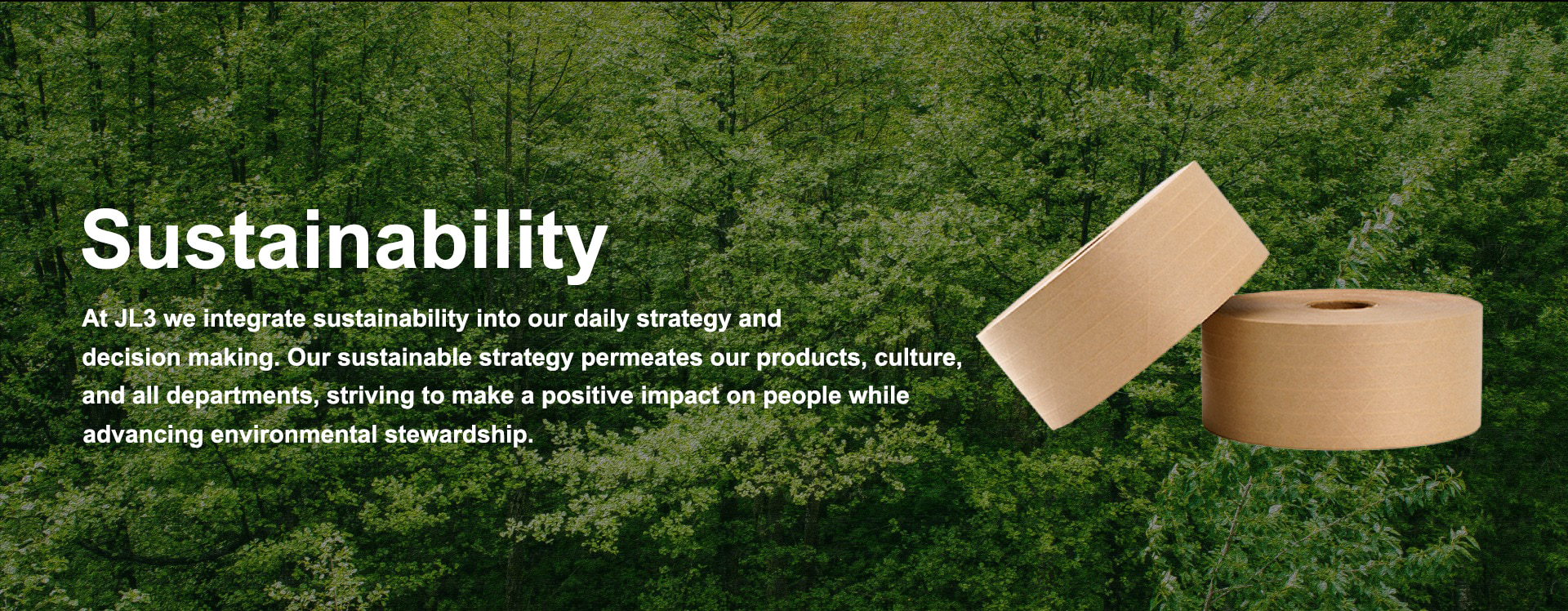
Water-activated kraft tape does not sit on the carton surface the way a pressure-sensitive film does; its adhesive wets into the board fibers and forms a single bonded layer with the carton itself. That gives export shipments three practical advantages: the seal resists peeling from a caught edge, because there is no film edge to lift; it is tamper-evident, because opening the carton tears the fibers and the damage cannot be smoothed away; and it is plastic-free and recyclable with the carton, which matters for shipments into the EU under the Packaging and Packaging Waste Regulation, where JL3 tapes were tested in 2026 with PFAS not detected. For cartons that will be opened and resealed at the destination, or for short domestic legs, a pressure-sensitive tape may still be the right call — but for a sealed export carton, the fiber bond is the safer default.
Start with the same weight bands used for domestic cartons, then step up one level of protection for export: an H-seal for any carton that will be stacked or handled more than twice, and a reinforced grade for cartons over 55 lb or for cartons whose contents are dense, sharp-edged, or valuable enough that a split seam is a claim, not an inconvenience.
| Carton weight | Water-activated grades | Export addition |
|---|---|---|
| Up to 10 lb | JLN-370 / JLN-382 | Center seal; H-seal if palletized |
| 10–35 lb | JLN-3140 / JLN-3150 | H-seal as standard |
| 35–55 lb | JLN-3160 / JLN-3750 | H-seal as standard |
| 55–90 lb | JLN-3780 | H-seal plus reinforced end strips |
| Over 90 lb | JLN-37120 / JLN-37120R (reinforced) | H-seal plus filament strapping for the load |
For the heaviest export cartons, tape alone is not the whole answer: add filament tape strapping around the carton to carry the load, so the seal is not asked to do a strapping job. The rule: tape seals the carton, strapping carries the load, and confusing the two is how export seams fail.
1. Seal only dry cartons. Check board for dampness before sealing; a seal laid on damp board starts weak and never recovers. 2. Overlap at least 2 inches onto each side panel. Short overlaps are the first thing to lift in transit. 3. H-seal every export carton over 10 lb. The end strips are what stop flap lift when a carton is dragged or dropped. 4. Let the bond set before stacking. Give water-activated seals a short dwell before the next carton goes on top, so the bond is not sheared while still forming. 5. Mark and photograph the seal. A photo of the sealed carton at dispatch settles most arrival disputes in one message: the seal either arrived as photographed, or it did not.
Before a carton leaves for export: (1) carton dry, undamaged, and correctly sized for its contents with void fill where needed; (2) grade matched to carton weight from the table above; (3) H-seal applied, overlaps at least 2 inches on side panels; (4) strapping added for cartons over 90 lb or with dense contents; (5) seal photographed and carton marked with destination and handling information; (6) tape within shelf life — water-activated tape 2 years, self-adhesive tape 1 year — and stored dry. Run this list at the export bench, not at the loading dock, where it is too late to reseal properly.
JL3 supplies export sealing as a matched set — water-activated kraft and reinforced tapes by carton weight, tamper-evident seals, filament strapping for heavy loads, and manual and electric dispensers for export packing benches — contact us through the inquiry form with your destination markets, carton weights, and transit time and we will specify the seal with you. Tape performance values are laboratory averages; test on your own cartons before committing.




 شبكة IPv6 مدعومة